Fertility Treatment Options: From Trying Naturally to IUI & IVF — Complete Guide
This article is part of our guide on IVF Treatment in Chennai — see the full treatment overview, success rates, and costs.
One of the most common questions couples ask me during their first consultation is — where do we even start?
When you search for fertility treatment online, IVF is often the first thing that appears. This can be overwhelming, and many couples assume IVF is their only option. The reality is quite different. In my 15+ years of practice in Chennai, I've guided thousands of couples through their fertility journey, and a significant number of them conceived with much simpler interventions — sometimes just lifestyle changes and properly timed intercourse.
Fertility treatment isn't a single step. It's a carefully planned journey that starts with the least invasive approach and escalates only when necessary. My philosophy has always been to recommend the simplest effective treatment first. Not every couple needs IVF, and not every couple follows the same path. Your age, diagnosis, and how long you've been trying all determine where you start and how quickly you progress.
This guide walks you through the complete fertility treatment journey — from natural conception attempts to advanced reproductive technologies like IVF. At each stage, I'll explain what happens, how long to try, what it costs, and when it's time to move to the next step.
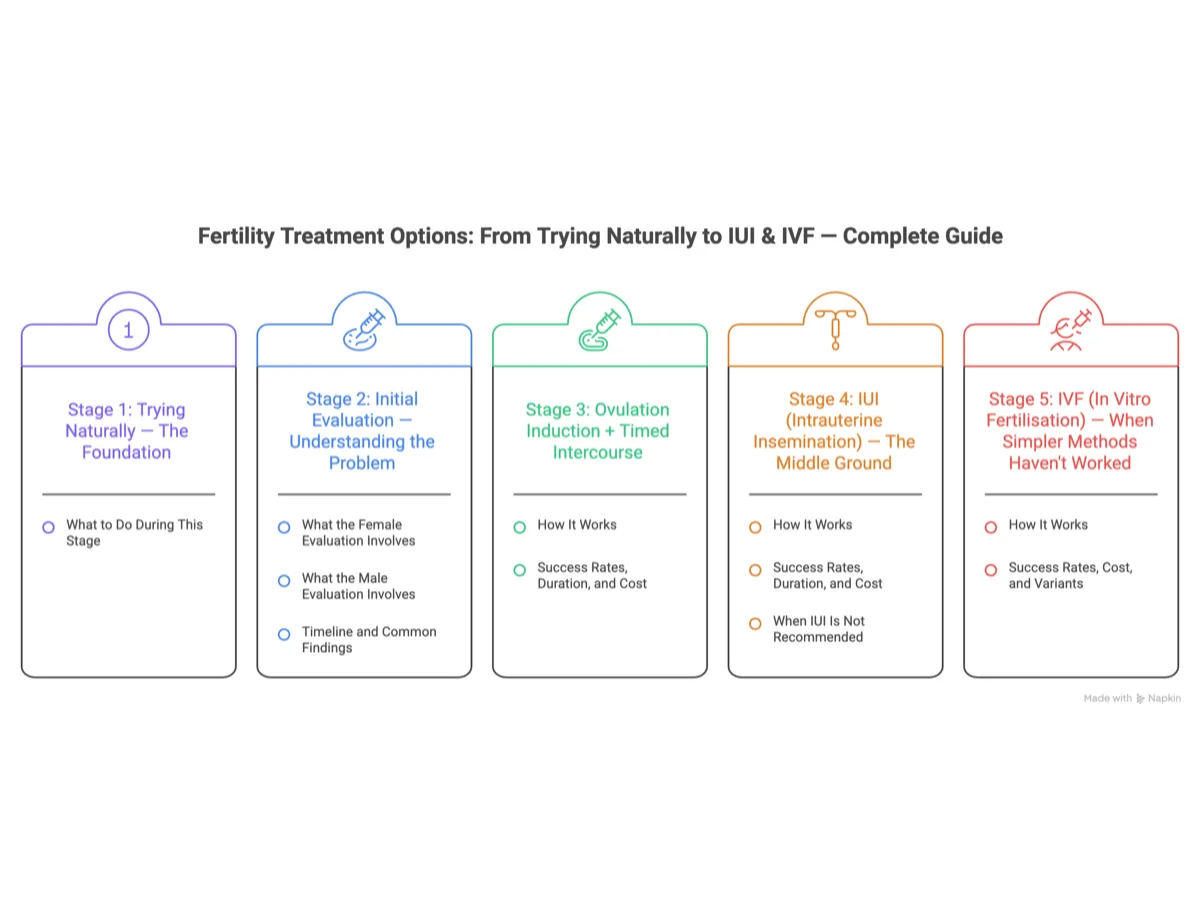
Stage 1: Trying Naturally — The Foundation
Before seeking medical intervention, most couples should give natural conception a fair chance — but with a strategic approach, not just "waiting and hoping."
Who this stage is for: Couples under 35 with no known fertility issues, who have been trying for less than 12 months.
What to Do During This Stage
Track your ovulation. Understanding your fertile window is the single most impactful thing you can do. Use ovulation predictor kits (OPKs), track your basal body temperature, or monitor cervical mucus changes. Most women ovulate around days 12-16 of a 28-day cycle, but this varies significantly. Having intercourse every 1-2 days during this window maximises your chances.
Optimise your lifestyle. Both partners should focus on:
- Maintaining a healthy BMI (18.5-24.9) — being significantly underweight or overweight affects fertility
- Eating a balanced diet rich in whole grains, lean proteins, fruits, and vegetables
- Quitting smoking and limiting alcohol — both have a direct negative impact on egg and sperm quality
- Managing stress through exercise, adequate sleep, and relaxation techniques
- Starting folic acid supplementation (400-800 mcg daily) for women
- Ensuring adequate zinc, selenium, and antioxidant intake for men
How long should you try naturally?
- Under 35: Up to 12 months of well-timed intercourse
- 35 to 39: Maximum 6 months before seeking evaluation
- 40 and above: Consult a fertility specialist immediately — time is a critical factor
When to move on: If you haven't conceived within the recommended timeline, if you have irregular or absent periods, or if either partner has known risk factors such as PCOS, endometriosis, previous pelvic surgery, or a history of testicular issues. Don't wait the full timeline if something feels off — early evaluation never hurts.
Related reading: How Lifestyle Affects Male Fertility | Weight, BMI & Fertility | Foods That Improve Sperm Health
Stage 2: Initial Evaluation — Understanding the Problem
This is perhaps the most important stage of the entire journey. A thorough evaluation tells us exactly what we're dealing with and directly determines which treatment path is right for you.
The most critical thing to understand: Fertility evaluation is for both partners, not just the woman. In my practice, I insist on evaluating both partners from the very first visit. Male factor infertility accounts for approximately 40% of all cases — skipping the semen analysis wastes valuable time.
What the Female Evaluation Involves
- Hormonal blood tests: AMH (ovarian reserve), FSH, LH, estradiol, thyroid hormones (TSH), and prolactin — these paint a picture of your hormonal health and egg reserve
- Pelvic ultrasound: To check your antral follicle count (AFC), ovarian morphology, uterine structure, and rule out fibroids or polyps
- Hysterosalpingography (HSG): An X-ray test to check whether your fallopian tubes are open — blocked tubes change the treatment plan significantly
- Additional tests as needed: Vitamin D levels, insulin resistance markers, infection screening
What the Male Evaluation Involves
- Semen analysis: This single test evaluates sperm count, motility (movement), morphology (shape), and volume. It's simple, inexpensive, and provides crucial information
- Further testing if needed: Hormonal evaluation, ultrasound, or DNA fragmentation analysis based on initial results
Timeline and Common Findings
Most evaluations can be completed within 1-2 menstrual cycles. The most common findings I see in my Chennai practice include:
- PCOS (Polycystic Ovary Syndrome): The most common cause of female infertility, causing irregular ovulation
- Low ovarian reserve: Reduced egg quantity, often detected through low AMH levels
- Tubal factor: Blocked or damaged fallopian tubes, often from past infections or endometriosis
- Male factor: Low sperm count, poor motility, or abnormal morphology — found in approximately 40% of couples
- Unexplained infertility: All tests come back normal, yet conception hasn't occurred — accounts for 15-20% of cases
The key takeaway: Your diagnosis determines your path. A couple with PCOS and normal tubes follows a very different route than a couple with bilateral tubal blockage. Some diagnoses allow us to start with simpler treatments, while others warrant moving directly to IVF.
Related reading: Understanding Your Fertility Test Results | How to Read a Semen Analysis Report | AMH Levels & Ovarian Reserve | When Should You See a Fertility Doctor?
Stage 3: Ovulation Induction + Timed Intercourse
For many couples, this is the first line of medical treatment — and it's remarkably effective for the right candidates.
Who this stage is for: Women with irregular or absent ovulation (particularly PCOS), couples with unexplained infertility as a first-line approach, and younger couples where the male partner's semen analysis is normal or near-normal.
How It Works
The goal is simple: help the ovaries produce one or two mature eggs at a predictable time, and then time intercourse precisely.
Step 1 — Medication. Your doctor prescribes an ovulation-inducing medication, taken early in your menstrual cycle (usually days 2-5):
- Letrozole (Femara): Currently the first-choice medication for ovulation induction, particularly in PCOS. It works by temporarily lowering oestrogen, which stimulates the brain to release more FSH, encouraging follicle growth.
- Clomiphene citrate (Clomid): An older but still effective option. Works by blocking oestrogen receptors, similarly stimulating FSH release.
Step 2 — Follicular monitoring. Serial ultrasound scans (typically 2-3 per cycle) track the growing follicle(s) in your ovaries. We're looking for at least one follicle reaching 18-22mm in diameter — a sign that the egg inside is mature.
Step 3 — Trigger shot. When the follicle is ready, an hCG injection triggers ovulation within 36-40 hours.
Step 4 — Timed intercourse. Intercourse is timed around the expected ovulation window for maximum chances.
Success Rates, Duration, and Cost
- Ovulation rate: 70-80% of women will ovulate with medication
- Pregnancy rate: 15-20% per cycle (with properly timed intercourse)
- Recommended duration: 3-4 cycles. If pregnancy hasn't occurred after 3-4 well-monitored, medicated cycles, it's time to consider the next step.
- Approximate cost in Chennai: ₹3,000-5,000 per cycle (medications + monitoring scans)
When to move on: No pregnancy after 3-4 medicated cycles, or if you're over 38 — at which point the lower per-cycle success rate means you shouldn't spend too many cycles at this stage.
Related reading: Ovulation Induction Medications Explained | Clomid vs. Letrozole | Follicular Monitoring Guide
Stage 4: IUI (Intrauterine Insemination) — The Middle Ground
IUI bridges the gap between simple timed intercourse and the complexity of IVF. It's less invasive, less expensive, and suitable for a range of diagnoses.
Who this stage is for: Couples with mild male factor infertility (slightly low count or motility), unexplained infertility, cervical factor issues, or those who didn't achieve pregnancy with ovulation induction and timed intercourse alone.
How It Works
The ovarian stimulation process is the same as Stage 3 — medications, follicular monitoring, and trigger shot. The difference is what happens on the day of ovulation:
- Sperm collection and processing. The male partner provides a semen sample on the day of the procedure. The sample is then "washed" and concentrated in the laboratory — this separates the healthiest, most motile sperm from the rest of the sample and removes seminal fluid.
- Insemination. The concentrated sperm sample is placed directly into the uterus through a thin, flexible catheter. This bypasses the cervix entirely and delivers millions of healthy sperm much closer to the fallopian tubes where fertilisation occurs.
- The procedure itself. It takes about 5 minutes, requires no anaesthesia, and feels similar to a pap smear. Most women experience no pain — at most, mild cramping that resolves quickly. You can resume normal activities immediately.
Success Rates, Duration, and Cost
- Pregnancy rate: 10-15% per individual cycle. This may seem modest, but the cumulative success rate over 3-4 cycles is approximately 30-40%.
- Recommended duration: 3-4 cycles (some couples may try up to 6, but beyond that, success rates don't improve significantly)
- Approximate cost in Chennai: ₹8,000-15,000 per cycle (including medications, monitoring, and the procedure)
When IUI Is Not Recommended
IUI is not the right choice for every couple. It's not appropriate when:
- Both fallopian tubes are blocked — sperm needs at least one open tube to reach the egg
- There is severe male factor infertility (very low count or motility) — not enough viable sperm even after processing
- The woman's age is above 40 — per-cycle success rates are too low to justify multiple attempts
- There are other indications that warrant IVF directly
When to move on to IVF: No pregnancy after 3-6 well-timed IUI cycles, diagnosis of severe male factor or tubal damage, or age-related urgency.
Related reading: IUI Treatment Process & Success Rates | IUI Success Rates by Age | How Many IUI Cycles Before IVF?
Stage 5: IVF (In Vitro Fertilisation) — When Simpler Methods Haven't Worked
IVF is the most advanced and effective fertility treatment available. While it's more complex and expensive than earlier stages, it offers the highest per-cycle success rates and can overcome virtually every cause of infertility.
Who this stage is for: Couples who haven't conceived with IUI, those with severe male factor infertility, bilateral tubal blockage, advanced endometriosis, significantly low ovarian reserve, women over 38-40, and unexplained infertility that hasn't responded to simpler treatments.
How It Works
IVF involves fertilising eggs outside the body in a controlled laboratory environment:
Ovarian stimulation (10-12 days). You receive daily hormone injections (gonadotropins) to stimulate your ovaries to produce multiple eggs instead of the usual one. Regular blood tests and ultrasound scans monitor your response, and dosages are adjusted in real time.
Egg retrieval. When the follicles are mature, eggs are collected through a minor procedure performed under light sedation. A thin needle is guided through the vaginal wall to the ovaries using ultrasound. The entire procedure takes about 15-20 minutes, and you go home the same day.
Fertilisation. The retrieved eggs are combined with the partner's sperm in the laboratory. Depending on the situation, we use either conventional IVF (eggs and sperm are placed together) or ICSI (intracytoplasmic sperm injection), where a single sperm is injected directly into each egg. ICSI is recommended for severe male factor infertility, previous fertilisation failure, or when using surgically retrieved sperm.
Embryo culture and monitoring. Fertilised eggs develop into embryos over 3-5 days in carefully controlled incubators. The embryology team monitors their progress daily. This is where my approach as a fertility specialist is different — I personally work alongside the embryologists during embryo selection and culture, making real-time decisions about your embryos. This hands-on involvement in the IVF lab is rare among fertility specialists, and I believe it leads to better outcomes.
Embryo transfer. The best-quality embryo is selected and transferred into the uterus through a thin catheter. This is a painless procedure that takes just a few minutes. In most cases, we transfer a single embryo to reduce the risk of multiple pregnancies.
The two-week wait. After transfer, you wait approximately 14 days before taking a blood pregnancy test (beta-hCG) to confirm whether implantation has occurred.
Success Rates, Cost, and Variants
- Success rates: 50-70% per cycle for women under 35, with rates decreasing gradually with age — 40-50% at 35-37, 30-40% at 38-40, and under 20% for women over 40
- Approximate cost in Chennai: ₹1,50,000-2,50,000 per cycle (depending on medications, ICSI, and additional procedures like embryo freezing)
IVF variants you may hear about:
- ICSI: For severe male factor — the embryologist injects a single sperm directly into the egg
- Frozen embryo transfer (FET): Extra embryos from your IVF cycle can be frozen and transferred in a future cycle, avoiding the need for repeated egg retrieval
- Donor egg or sperm IVF: When a couple's own eggs or sperm aren't viable, using donor gametes with IVF can offer a path to pregnancy
Related reading: IVF Step-by-Step Process | Your First IVF Cycle — What to Expect | Who Should Consider IVF? | IVF vs. IUI — Which Treatment Is Right for You?
Not Everyone Follows This Exact Path
While this guide presents treatment as a sequence of stages, the reality is that fertility treatment isn't always linear. Your fertility specialist's job is to recommend the right starting point for your specific situation — not to make you go through every step.
Some couples skip stages entirely:
- A couple with bilateral tubal blockage will move directly to IVF — there's no point trying IUI when the tubes are blocked
- Severe male factor infertility (such as azoospermia, where no sperm is found in the ejaculate) may require surgical sperm retrieval combined with ICSI, bypassing all earlier stages
- Women with very low AMH or those aged 40 and above may benefit from going directly to IVF rather than spending valuable time on treatments with lower success rates
Some couples go backwards:
- I've had patients who were preparing for their next IVF cycle and conceived naturally during the waiting period — sometimes the stress reduction of having a plan in place makes a difference
- A woman with PCOS who struggled to ovulate, lost 10% of her body weight during treatment preparation, and began ovulating regularly on her own
Age is the single most important variable. I cannot stress this enough. A 28-year-old with PCOS has time to try ovulation induction for 3-4 cycles before considering IUI. A 39-year-old with the same diagnosis may benefit from a more aggressive approach — perhaps starting with IUI directly or even considering IVF sooner. Every month matters when ovarian reserve is declining.
The stages in this guide give you a framework, but your treatment plan should always be personalised. Trust your fertility specialist to guide you to the most appropriate starting point.
How I Help Couples at Each Stage
My approach to fertility treatment is rooted in a simple principle: give the simplest effective treatment first. I won't recommend IVF if IUI has a strong chance of working for you, and I won't recommend IUI if ovulation induction alone is likely to be enough.
Every couple who walks into my clinic receives a personalised treatment plan from day one. I sit down with both partners, explain the findings from their evaluation in plain language, and map out a clear path forward — including realistic expectations for success at each stage, approximate timelines, and costs.
What sets my practice apart is my direct involvement in the IVF laboratory. Unlike many fertility specialists who hand off the lab work entirely, I personally participate in embryo selection and culture alongside the embryology team. This allows me to make clinical decisions in real time during the most critical phase of IVF treatment.
With international training from the Royal College of Obstetricians and Gynaecologists (UK) and a Fellowship in Reproductive Medicine from Kiel University (Germany), combined with over 15 years of hands-on experience in Chennai, I bring a global perspective to local care. Over 3,000 couples and a 70% IVF success rate reflect this commitment.
If you're unsure where you are in your fertility journey, a single consultation can give you clarity. We'll evaluate both partners, identify the cause, and give you a clear, honest treatment roadmap — no unnecessary steps, no wasted time.
When to Seek Professional Help
Don't wait until you've exhausted every home remedy or spent years hoping things will change on their own. Seek a fertility evaluation if:
- You're under 35 and haven't conceived after 12 months of regular, well-timed intercourse
- You're 35-39 and haven't conceived after 6 months
- You're 40 or older and want to start a family — consult immediately
- You have irregular, infrequent, or absent periods
- You or your partner have a known medical condition that could affect fertility
- You've experienced recurrent miscarriages
Early evaluation doesn't commit you to treatment — it gives you information. And information is the foundation of every good decision.
Dr. Rukkayal Fathima is a fertility specialist practising across the seven Yaal Fertility centres in Chennai including Kilpauk, Mylapore and Thiruvanmiyur, with extensive experience in guiding couples through every stage of the fertility treatment journey. For personalised guidance, book a consultation with Dr. Rukkayal Fathima.

Dr. Rukkayal Fathima
MBBS, MS (OBG), MRCOG (UK), FRM (Kiel University)
Fertility Specialist, Obstetrician, Gynecologist & Laparoscopic Surgeon
Dr. Rukkayal Fathima is a fertility specialist, obstetrician and gynaecologist in Chennai. She has 15+ years of experience and treated 3000+ patients. She specialises in IVF, ICSI, TESA/Micro TESE, IUI, Early Pregnancy Scan, Menopause advice, and Gynaecological surgeries. She is the Founder & Director of Yaal Fertility and Women's Centre, which runs 7 fertility centres across Chennai.
Have Questions About IVF Treatment?
Every situation is unique. Dr. Rukkayal Fathima provides personalised, evidence-based guidance across multiple locations in Chennai.
Frequently Asked Questions
No. Many couples conceive with simpler treatments like ovulation induction or IUI. IVF is reserved for specific diagnoses such as blocked fallopian tubes, severe male factor infertility, or when other treatments haven't worked after adequate trials.
It varies widely depending on your diagnosis and age. Some couples conceive within 2-3 months of starting medication. Others may need 6-12 months including IVF. Age and the underlying cause of infertility are the biggest factors that determine the timeline.
Yes, in many cases. Weight management, stress reduction, quitting smoking, and proper nutrition can significantly improve fertility — especially for women with PCOS. However, don't delay professional evaluation if you're over 35 or have known risk factors.
No. IUI is a quick 5-minute procedure that feels similar to a routine pap smear. No anaesthesia is required, and most women resume normal activities immediately after.
Costs range from ₹3,000-5,000 per cycle for ovulation induction with timed intercourse, to ₹8,000-15,000 per cycle for IUI, to ₹1,50,000-2,50,000 per cycle for IVF. Most couples don't need the most expensive option — treatment is tailored to your specific diagnosis.
Absolutely. Male factor infertility contributes to approximately 40% of all infertility cases. A semen analysis is simple, inexpensive, and essential. Evaluating both partners from the start prevents unnecessary delays and ensures the right treatment approach.
A fertility specialist will recommend the most appropriate starting point based on your diagnosis, age, and how long you've been trying to conceive. The first consultation typically includes a thorough evaluation that gives you a clear treatment roadmap.
Consult Dr. Rukkayal at Yaal Fertility, Chennai
Dr. Rukkayal is the Founder & Director of Yaal Fertility and Women's Centre and consults at all 7 Yaal centres. Walk-ins welcome; appointments preferred.
Full hospital · IVF lab & ICU
No. 747, Poonamallee High Road, Alagappa Nagar, Kilpauk, Chennai – 600 010
Theatre & recovery
First Floor, Kumar Towers, Bus Depot, Opp. Padianallur, PT Murthy Nagar, Padiyanallur, Red Hills, Chennai – 600 052
IVF lab & theatre
2nd Floor, Dr. Mehta's Global Campus, No. 50, Poonamallee High Road, Velappanchavadi, Thiruverkadu, Chennai – 600 077
Consultation & andrology lab
No. 149/1, Luz Church Road, Bhaskarapuram, Mylapore, Chennai – 600 004
IVF lab & theatre
Second Floor, No. 1, 3rd Street, Malaviya Avenue, Thiruvanmiyur, Chennai – 600 041
Consultation & andrology lab
No. 95, Plot No. 1, Velachery Main Road, Devi Karumariamman Nagar, Pallikaranai, Chennai – 600 100
Consultation & andrology lab
3/5, Kannan Nagar 3rd Main Road, Vigneshwar Nagar, Madipakkam, Chennai – 600 091
Book any centre on the Yaal line, +91 75500 06704. Compare all Yaal centres