IVF Step by Step in Chennai: The Full Process

This article is part of our guide on IVF Treatment in Chennai — see the full treatment overview, success rates, and costs.
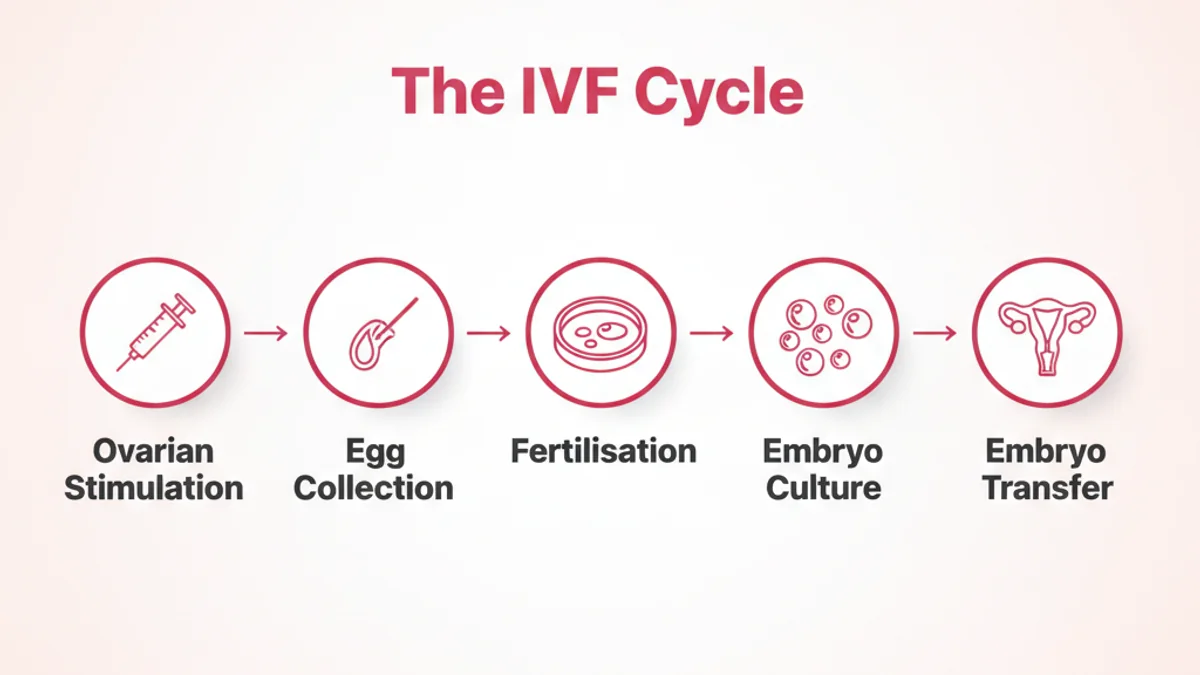
In vitro fertilization (IVF) is a complex but well-established process designed to help individuals and couples struggling with infertility. The IVF step by step process involves several key stages, from initial consultations and ovarian stimulation to egg retrieval, fertilization, embryo culture, and finally, embryo transfer. This guide, tailored for patients in Chennai, will explain each step in detail, addressing common concerns and providing a clear understanding of what to expect.
What Is IVF and How Does It Work
IVF, or In Vitro Fertilization, is a type of assisted reproductive technology (ART) that involves fertilizing an egg with sperm outside the body, in a specialized laboratory. The term "in vitro" literally means "in glass," highlighting that the fertilization occurs in a lab dish rather than inside the woman's body. After fertilization, the resulting embryo(s) are cultured for a few days before being transferred into the woman's uterus, with the hope of achieving a successful pregnancy. IVF is a highly effective treatment for various fertility issues, including blocked fallopian tubes, male factor infertility, unexplained infertility, and advanced maternal age. IVF bypasses damaged or blocked fallopian tubes by directly placing the embryo into the uterus. In my clinical experience, many patients find comfort in understanding the detailed steps of IVF, as it empowers them to actively participate in their fertility journey. The basic steps include ovarian stimulation, egg retrieval, fertilization, embryo culture, and embryo transfer. The process can seem daunting, but breaking it down into manageable steps helps alleviate anxiety and fosters a sense of control. It's also important to remember that each patient's experience with IVF is unique and tailored to their specific needs and medical history.
Who Needs IVF
IVF is a suitable treatment option for a diverse range of fertility challenges. Women with damaged or blocked fallopian tubes, which prevent the natural fertilization of the egg, often benefit from IVF as it bypasses the tubes entirely. Couples facing male factor infertility, such as low sperm count, poor sperm motility, or abnormal sperm morphology, can also find success with IVF, often combined with intracytoplasmic sperm injection (ICSI), where a single sperm is directly injected into the egg. Women with ovulation disorders, such as polycystic ovary syndrome (PCOS), may consider IVF if other treatments like ovulation induction and IUI have been unsuccessful. Additionally, couples with unexplained infertility, where the cause of infertility cannot be identified through standard testing, may turn to IVF as a comprehensive approach to achieving pregnancy. As a fertility specialist in Chennai, I’ve seen many couples benefit from IVF when other treatments have failed. Women experiencing endometriosis, a condition where the uterine lining grows outside the uterus, can also benefit from IVF, as endometriosis can affect both egg quality and implantation. In cases of advanced maternal age, where egg quality and quantity decline, IVF offers a chance to conceive using their own eggs or donor eggs. Furthermore, individuals or couples who carry a genetic disorder may opt for IVF with preimplantation genetic testing (PGT) to screen embryos for the condition before transfer.
IVF Step-by-Step Process
The IVF process involves several carefully orchestrated steps, each playing a crucial role in the overall success of the treatment.
-
Initial Consultation and Testing: The journey begins with a comprehensive consultation with a fertility specialist. This involves a review of your medical history, a physical examination, and various diagnostic tests to assess your fertility status. These tests may include blood tests to measure hormone levels (such as FSH, LH, AMH), a transvaginal ultrasound to evaluate the ovaries and uterus, and semen analysis for the male partner. The results of these tests help the doctor tailor the IVF protocol to your specific needs.
-
Ovarian Stimulation: This stage involves the administration of hormone medications, typically follicle-stimulating hormone (FSH) and luteinizing hormone (LH), to stimulate the ovaries to produce multiple eggs. The goal is to retrieve more than one egg, as not all eggs will fertilize or develop into viable embryos. Gonadotropin-releasing hormone (GnRH) agonists or antagonists may also be used to prevent premature ovulation. The duration of ovarian stimulation is typically 8-14 days, during which you'll need to visit the clinic for regular monitoring.
-
Monitoring: Regular monitoring is essential during ovarian stimulation to track the development of follicles (fluid-filled sacs containing the eggs). This involves blood tests to measure hormone levels (estradiol and progesterone) and transvaginal ultrasounds to visualize the follicles and measure their size. Based on the results, the doctor may adjust the medication dosage to optimize follicle growth and egg maturation.
-
Trigger Shot: Once the follicles reach an optimal size, a "trigger shot" is administered. This injection, usually human chorionic gonadotropin (hCG) or a GnRH agonist, triggers the final maturation of the eggs and prepares them for retrieval. Egg retrieval is scheduled approximately 34-36 hours after the trigger shot.
-
Egg Retrieval: Egg retrieval is a minimally invasive procedure performed under sedation or local anaesthesia. Using transvaginal ultrasound guidance, a needle is inserted through the vaginal wall into the ovaries to aspirate fluid from each follicle. The fluid is then examined in the lab to identify and collect the eggs. The procedure typically takes less than 30 minutes, and most patients experience mild discomfort.
-
Sperm Collection: On the day of egg retrieval, a sperm sample is collected from the male partner. In some cases, the sperm may have been collected and frozen beforehand. If there are issues with sperm quality, a procedure called testicular sperm aspiration (TESA) or micro-TESE may be necessary to retrieve sperm directly from the testicles.
-
Fertilization: The eggs and sperm are then combined in the laboratory to facilitate fertilization. This can be done using traditional insemination, where the eggs and sperm are mixed together in a dish, or intracytoplasmic sperm injection (ICSI), where a single sperm is injected directly into each egg. ICSI is often used when there are concerns about sperm quality or when previous IVF cycles have failed.
-
Embryo Culture: After fertilization, the resulting embryos are cultured in the lab for several days. Embryologists monitor the embryos' development, assessing their quality based on cell number, symmetry, and fragmentation. Embryos are typically graded on days 3 and 5 (blastocyst stage).
-
Embryo Transfer: Embryo transfer is a simple and painless procedure that involves placing one or more embryos into the woman's uterus using a thin catheter. The number of embryos transferred depends on factors such as age, embryo quality, and patient preference. In many cases, single embryo transfer (SET) is recommended to minimize the risk of multiple pregnancies.
-
Luteal Phase Support: After embryo transfer, progesterone supplementation is often prescribed to support the uterine lining and increase the chances of implantation. Progesterone can be administered as injections, vaginal suppositories, or oral medications.
-
Pregnancy Test: Approximately 10-14 days after embryo transfer, a blood test is performed to measure the levels of human chorionic gonadotropin (hCG), a hormone produced during pregnancy. A positive hCG test confirms pregnancy.
Success Rates of IVF
IVF success rates can vary significantly depending on several factors, including the woman's age, the cause of infertility, embryo quality, and the clinic's expertise. Generally, younger women have higher success rates than older women due to better egg quality. According to recent data, women under 35 have an average IVF success rate of 45-50% per cycle, while women between 35 and 40 have a success rate of 30-40%. For women over 40, the success rate drops to 10-20% per cycle. It's important to note that these are just averages, and individual success rates can vary. At my practice, we strive to maintain realistic and evidence-based success rates, focusing on personalized treatment plans to optimize each patient's chances of success. For example, in our Chennai clinics, we see a 65%+ IVF success rate, which is higher than the national average. This is due to a combination of factors, including advanced lab technology, experienced embryologists, and individualized treatment protocols.
| Factor | Success Rate Impact |
|---|---|
| Woman's Age | Under 35: 45-50% per cycle; 35-40: 30-40% per cycle; Over 40: 10-20% per cycle |
| Embryo Quality | High-quality embryos (graded A or B) have a significantly higher implantation rate compared to lower-quality embryos (graded C or D) |
| Cause of Infertility | Certain conditions, such as severe male factor infertility or diminished ovarian reserve, may lower success rates |
| Clinic Experience | Clinics with experienced staff and advanced technology tend to have higher success rates |
| Lifestyle Factors | Maintaining a healthy weight, avoiding smoking, and limiting alcohol consumption can improve IVF outcomes |
| Number of Cycles | Cumulative success rates increase with multiple IVF cycles; many couples achieve pregnancy after two or three cycles |
| Endometrial receptivity | A receptive endometrium (uterine lining) is crucial for successful implantation; endometrial receptivity analysis (ERA) may be used to assess receptivity and personalize embryo transfer timing if needed |
IVF Cost in Chennai
The cost of IVF treatment in Chennai can vary significantly depending on the clinic, the specific procedures required, and the medications used. On average, a single IVF cycle in Chennai can range from ₹1,50,000 to ₹3,00,000. This cost typically includes the doctor's fees, laboratory charges, egg retrieval, fertilization, embryo culture, and embryo transfer. However, it often does not include the cost of medications, which can add an additional ₹50,000 to ₹1,00,000 per cycle. Additional procedures, such as ICSI, preimplantation genetic testing (PGT), or frozen embryo transfer (FET), will also increase the overall cost.
Here is an approximate breakdown of what contributes to the total:
| Component | Approximate Cost (INR) |
|---|---|
| Base IVF cycle (consultation, monitoring, retrieval, transfer) | ₹1,50,000 - ₹3,00,000 |
| Ovarian stimulation medications | ₹50,000 - ₹1,00,000 |
| ICSI (if needed) | ₹15,000 - ₹30,000 |
| Embryo freezing (initial) | ₹20,000 - ₹40,000 |
| Frozen embryo transfer (FET) | ₹40,000 - ₹70,000 |
| PGT (if needed) | ₹40,000 - ₹3,00,000 |
Some clinics offer package deals that include multiple IVF cycles or a combination of treatments at a discounted price. It's important to inquire about these options and understand exactly what is included in the package. Many patients in Chennai also explore financing options or insurance coverage to help manage the cost of IVF. While most insurance plans in India do not cover IVF treatment, some employers may offer coverage as part of their employee benefits package. It's advisable to check with your insurance provider to determine if IVF is covered and what the specific terms and conditions are.
For a complete component-by-component breakdown — including add-on pricing, medication costs, and ways to make treatment more affordable — see our detailed guide on IVF cost in Chennai.
Disclaimer: The costs above are approximate ranges for Chennai in 2026 and will vary with your diagnosis, protocol, and medications. A precise estimate is provided after your initial consultation.
Risks and Side Effects
While IVF is generally a safe procedure, it is associated with certain risks and potential side effects. Ovarian hyperstimulation syndrome (OHSS) is a condition that can occur as a result of ovarian stimulation, causing the ovaries to become enlarged and fluid to accumulate in the abdomen. Mild OHSS is common and usually resolves on its own, but severe OHSS can be life-threatening and require hospitalization. Multiple pregnancies (twins, triplets, or more) are another risk of IVF, particularly when multiple embryos are transferred. Multiple pregnancies increase the risk of premature birth, low birth weight, and other complications for both the mother and the babies. Ectopic pregnancy, where the embryo implants outside the uterus, is also a potential risk, although it is rare. Miscarriage rates after IVF are similar to those of natural conception, but they do increase with maternal age. Other potential side effects of IVF include bloating, cramping, breast tenderness, mood swings, and headaches, which are typically mild and temporary. It's important to discuss these risks and side effects with your fertility specialist before starting IVF treatment.
What to Expect After IVF
After the embryo transfer, the two-week wait can be an emotionally challenging time. It's important to follow your doctor's instructions regarding medication and activity levels. Light activity is generally fine, but strenuous exercise and heavy lifting should be avoided. Many women experience mild cramping or spotting during this time, which can be concerning but is often normal. It's crucial to avoid self-diagnosing and to contact your clinic with any concerns. Maintaining a healthy diet, staying hydrated, and getting adequate rest are also important during the two-week wait. Stress management techniques, such as meditation, yoga, or spending time with loved ones, can help you cope with the anxiety and uncertainty. Approximately 10-14 days after the embryo transfer, you will undergo a blood test to measure hCG levels and determine if you are pregnant. If the test is positive, you will continue to be monitored with blood tests and ultrasounds to confirm a viable pregnancy. If the test is negative, it's important to allow yourself time to grieve and process the disappointment. Your doctor will discuss the options for future treatment cycles and make any necessary adjustments to the protocol. Remember that IVF is a journey, and it may take more than one cycle to achieve success.

When to Seek Professional Help
If you've been trying to conceive for a year without success (or six months if you're over 35), it's time to seek professional help from a fertility specialist. Early evaluation and treatment can significantly improve your chances of conceiving. It is particularly important to seek help if you have known risk factors for infertility, such as irregular periods, endometriosis, PCOS, male factor infertility, or a history of pelvic infections. A fertility specialist can perform a thorough evaluation to identify the underlying cause of your infertility and recommend the most appropriate treatment options. In Chennai, several experienced fertility specialists offer comprehensive care and personalized treatment plans. For personalised guidance, book a consultation with Dr. Rukkayal Fathima.

Dr. Rukkayal Fathima
MBBS, MS (OBG), MRCOG (UK), FRM (Kiel University)
Fertility Specialist, Obstetrician, Gynecologist & Laparoscopic Surgeon
Dr. Rukkayal Fathima is one of India's leading Gynaecologists and the best fertility doctor in Chennai. She has 12+ years of experience and treated 3000+ patients. She specialises in IVF, ICSI, TESA/Micro TESE, IUI, Early Pregnancy Scan, Menopause advice, and Gynaecological surgeries. She is a Co-founder & Director of Yaal Fertility and Women's Centre, the Best Fertility Center in Chennai.
Have Questions About IVF Treatment?
Every situation is unique. Dr. Rukkayal Fathima provides personalised, evidence-based guidance across multiple locations in Chennai.
Frequently Asked Questions
The first step usually involves ovarian stimulation, where hormone medications are administered to stimulate the ovaries to produce multiple eggs. This is preceded by pre-treatment with oral contraceptive pills or estrogen for 1-3 weeks to improve the number of mature eggs. Baseline blood tests and ultrasound are also performed.
From the start of ovarian stimulation to the pregnancy test, a typical IVF cycle takes approximately 4-6 weeks. However, the entire process, including initial consultations and pre-cycle testing, can extend over a couple of months.
The trigger shot, usually hCG or a GnRH agonist, is an injection given to induce the final maturation of the eggs. It's crucial because it prepares the eggs for fertilization and dictates the timing of the egg retrieval procedure, typically scheduled 34-36 hours after the injection.
The cost of IVF treatment in Chennai can vary, but typically ranges from ₹1,50,000 to ₹3,00,000 per cycle, excluding medications and pre-cycle testing. The final cost depends on the specific treatments and medications required.
Common risks include multiple pregnancies (twins or triplets), ovarian hyperstimulation syndrome (OHSS), ectopic pregnancy, miscarriage, and emotional stress. However, advancements in techniques minimize these risks.
Embryo grading is the process of evaluating the quality of embryos based on their cell number, symmetry, and degree of fragmentation. Higher-graded embryos have a greater chance of implantation and resulting in a successful pregnancy, which is why it is important.
Maintaining a healthy weight, eating a balanced diet rich in nutrients, managing stress, avoiding smoking and excessive alcohol consumption, and getting adequate sleep can positively impact IVF outcomes. A fertility-optimized meal plan can also increase pregnancy rates.
Consult Dr. Rukkayal in Chennai
Available at 4 fertility clinic locations across Chennai. Walk-ins welcome; appointments preferred.
No. 747, Poonamallee High Road, Alagappa Nagar, Kilpauk, Chennai – 600 010
No. 149/1, Luz Church Road, Bhaskarapuram, Mylapore, Chennai – 600 004
No. 95, Plot No. 1, Velachery Main Road, Devi Karumariamman Nagar, Pallikaranai, Chennai – 600 100
Dr. Rukkayal is also a visiting consultant at Apollo Hospital, Motherhood Hospital, Cloud Nine Hospital, MGM Hospital, Metha Hospital and St. Isabel Hospital in Chennai. View all clinic locations