Second Period After Laparoscopy: Why It's Late

This article is part of our guide on gynecology-care in Chennai — see the full treatment overview, success rates, and costs.
Quick answer: After a laparoscopy, the first period often arrives roughly on time but is heavier than usual. The second period is the one that tends to be late — typically by 5 to 14 days — because the ovary delayed ovulation that cycle. This is normal and not a sign of complications in most women. By the third period, your cycle should be back to its usual pattern. Please call your surgeon if you have fever, soaking bleeding, foul discharge, severe pain, or no period by 6–7 weeks.
"Doctor, my first period came after laparoscopy — very heavy, with clots, but it came. The next one is now 10 days late. Is something wrong?" I hear some version of this question almost every week in my Egmore clinic. The short, honest answer is: almost certainly nothing is wrong. Let me walk you through exactly why the second period is commonly late, what is normal, what is not, and when you genuinely need to call.

What laparoscopy does to your cycle — the short version
A laparoscopy is a minimally invasive pelvic surgery done under general anaesthesia. Even when the procedure itself is small (a diagnostic look, a cyst removal, endometriosis cauterisation), three things happen to your body that affect the menstrual cycle:
- General anaesthesia and surgical stress temporarily influence the hypothalamus — the brain region that signals the ovaries when to ovulate.
- Pelvic inflammation from the procedure changes the hormonal environment around the ovaries for a few weeks.
- If the ovaries were directly operated on (cyst removal, endometrioma, adhesiolysis near the ovary), the follicle development can be delayed for that cycle as the ovary recovers.
All three factors push this cycle's ovulation a bit later than usual. And because your period is always roughly 12–14 days after ovulation, a late ovulation means a late period.
Why the second period, not the first?
This is the part that confuses most patients. Here is the simple timeline.
- Cycle 1 (first period after surgery): This period comes from a lining that was already built up before your laparoscopy. Your ovary had already ovulated, and the lining was mostly ready. That is why the first period usually arrives close to its expected date — just heavier than normal because of the surgical inflammation and shedding of a slightly congested lining.
- Cycle 2 (second period after surgery): This is the first full cycle your body is running from scratch after the laparoscopy. The ovary has to recruit a new follicle, grow it, and ovulate it — and because of the anaesthetic and inflammatory effects, that ovulation is often 5 to 14 days later than usual. A delayed ovulation = a delayed period.
- Cycle 3 onwards: By the third period, your ovaries have recovered their normal rhythm. Most women are back to their baseline cycle length by cycle 3 or cycle 4.
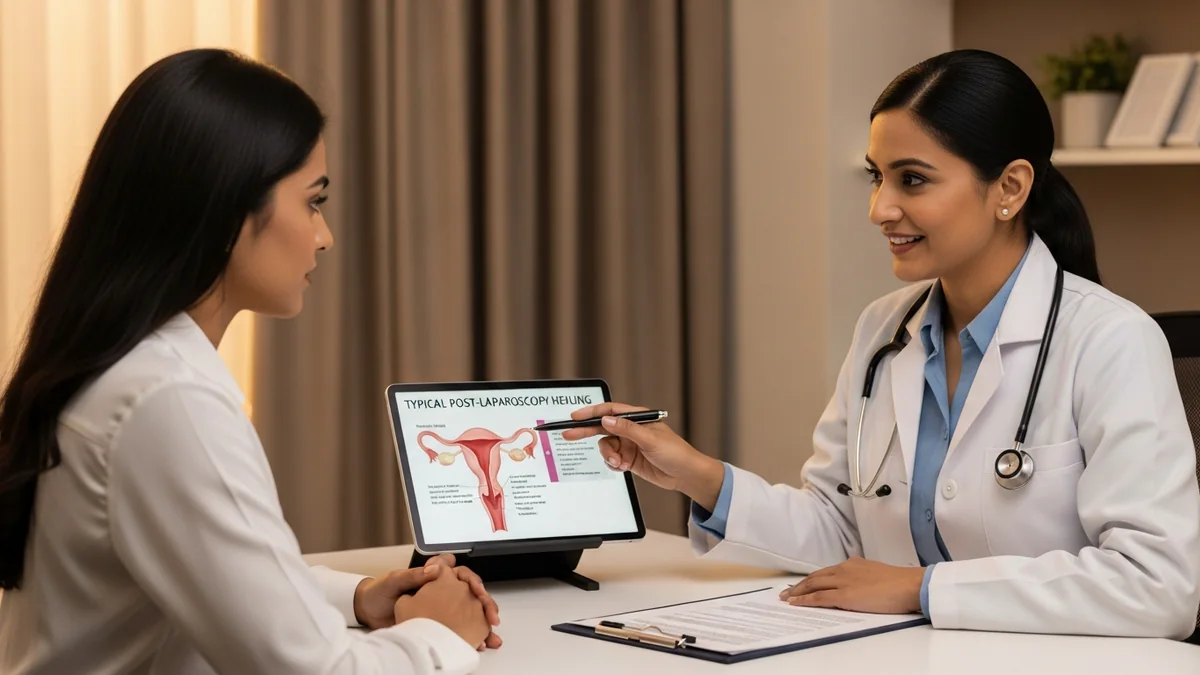
This is why, in my clinic, I specifically pre-warn patients at their post-op review: "Your first period may be heavy, your second period may be late, your third period should look like your old self."
Why the first period is often heavier
The first post-laparoscopy period can surprise patients. Flow is heavier than usual, the cramps can be stronger, clots are common, and it can last a day or two longer. The reasons are:
- Surgical inflammation increases local prostaglandin levels in the uterus, which makes contractions more intense and flow heavier.
- The lining that is shedding was already influenced by pre-surgery factors — endometriosis, cysts, or hormonal disruption — so the first shed is often a "big clean-out."
- Temporary hormonal disruption from the HPO axis makes the lining slightly less stable.
This is expected and almost always self-limiting. One heavier-than-usual period is normal. Bleeding soaking a full pad every hour for 2+ hours is not normal — that is a surgical complication until proven otherwise and needs to be seen the same day.
What is normal vs. what needs a call
Keep this table next to you for the first 2 cycles after surgery. It is the one I hand out in the clinic.
| Symptom | Normal (observe) | Call the surgeon today |
|---|---|---|
| First period timing | On time or up to 5 days late | No period by 6–7 weeks |
| First period flow | Heavier, some clots, lasts 5–7 days | Soaking a full pad every hour for 2+ hours |
| Pain during first period | More cramping, eases with paracetamol | Severe pain not improving with medication |
| Second period timing | 5–14 days late | More than 21 days late, or no period by 8 weeks |
| Second period flow | Normal to slightly light | Extremely heavy with clots, or soaking bleeding |
| Discharge | Clear or slightly bloody, no odour | Foul-smelling, yellow-green, or pus-like |
| Fever | None | Above 100°F |
| Abdominal pain | Mild, improving daily | One-sided, worsening, or with nausea/vomiting |
The second row of the "call today" column is the one patients most commonly miss: if your period is genuinely very late (beyond 3 weeks) and you had unprotected intercourse in this cycle, please do a urine pregnancy test before assuming it is surgical cycle disruption. A positive test after laparoscopy needs an early scan to confirm the pregnancy is in the right place.
Trying for pregnancy after laparoscopy
For most gynaecological laparoscopies — endometriosis, simple cyst removal, adhesiolysis, tubal dye test — you can usually try to conceive from the first normal cycle after surgery. In fact, the 6 to 12 months after a fertility-improving laparoscopy is often the most productive window in a woman's fertility journey. The pelvic environment has been improved, the inflammation is lower, and the tubes are open.
However, please confirm the safe trying window with your own operating surgeon if you had:
- Myomectomy (fibroid removal) — may need 3–6 months of rest depending on how deep the fibroid was
- Large endometrioma removal — usually 1–2 cycles to let the ovary recover
- Extensive adhesiolysis — depends on how much was done
- Tubal surgery — depends on the specific procedure
In general, when a patient asks me, "When can I start trying?" my answer is: as soon as the second period has ended, unless your operating surgeon has given you a specific number of cycles to wait.
Post-operative care for a smoother recovery
These are the things I ask my post-laparoscopy patients to do for the first 2–4 weeks. Nothing fancy — just what genuinely helps.
- Walk gently the same day. It reduces shoulder-tip pain from residual gas and helps the bowel recover.
- Avoid heavy lifting, running, and gym workouts for 2 weeks — 3–4 weeks if major surgery was done.
- Eat iron-rich food — dal, leafy greens, dates, lean meat, eggs. The first period is going to be heavier and you do not want to walk into it anaemic.
- Stay hydrated — 2 to 2.5 litres of water daily supports healing and prevents constipation.
- Paracetamol for cramps is fine. Avoid ibuprofen in the first 48 hours if your surgeon specifically said so.
- Keep the port sites dry for 48 hours, then normal showering is fine.
- Watch for a fever — low-grade fever on day 1–2 is common, but anything above 100°F after day 3 should be reported.
- Attend your post-op review even if you feel fine. This is when we confirm healing, discuss biopsy results, and plan your fertility timeline.
Myths I correct in the clinic
Myth 1: "The surgery damaged my ovaries and my cycle will never be the same." — No. Unless the surgery specifically removed a large amount of ovarian tissue (uncommon and only for specific conditions), your cycle returns to baseline within 2–3 months in nearly all cases.
Myth 2: "A late period means infection." — No. Late second periods are a hormonal and follicular phenomenon, not an infectious one. Infection shows up differently — fever, pain, foul discharge, rising inflammation — not by delaying a period.
Myth 3: "I should take medicine to force the period." — Please do not self-medicate with Provera, Meprate, or any progestogen without your surgeon's advice. These are sometimes given for a reason, but starting them yourself can delay the actual ovulation further and confuse the picture.
Myth 4: "Laparoscopy ruins fertility." — The opposite is usually true. Laparoscopy is one of the strongest fertility tools we have in gynaecology. Most fertility-focused laparoscopies improve the monthly chance of pregnancy for the next 6–12 months.
When to see me
Please book a consultation if:
- Your second period is more than 21 days late
- No period has arrived by 7–8 weeks after surgery (first rule out pregnancy)
- Your periods are still heavy, painful, or irregular by cycle 3 or cycle 4
- You had a laparoscopy for endometriosis or fibroids and want to plan a pregnancy timeline
- You are currently trying to conceive after a laparoscopy and want a fertility-focused plan
- You want a second opinion on a proposed laparoscopy or post-op care plan
You can book an appointment at my Egmore clinic (morning 8 AM – 2 PM), at the Mylapore branch for an evening slot (5 PM – 9 PM), or at Tambaram on Thursdays and Sundays between 2 PM and 4 PM. Post-operative reviews, cycle tracking, and fertility planning after laparoscopy are all things I handle myself rather than delegating — because the 3–6 months after a pelvic surgery are often the most fertile window in a woman's journey and deserve focused attention.
In a word
The second period after laparoscopy is usually late, the first one is usually heavy, and by the third cycle you should be back to your old self. None of this is a sign that surgery "went wrong." It is your ovaries taking one cycle to reset after anaesthesia and healing. The rare symptoms that genuinely need a call — fever, soaking bleeding, foul discharge, severe pain, or no period by 7 weeks — are very specific and easy to recognise. Everything else is biology doing its job.
Related reading
- Period after hysteroscopy — what to expect — the cycle pattern after the other common scope procedure.
- Laparoscopy infertility guide — when laparoscopy is useful in a fertility workup.
- Laparoscopy cost in Chennai — honest pricing and what you are paying for.
For a fuller overview of gynaecological surgery and fertility care, see my endoscopy & laparoscopy page.

Dr. Rukkayal Fathima
MBBS, MS (OBG), MRCOG (UK), FRM (Kiel University)
Fertility Specialist, Obstetrician, Gynecologist & Laparoscopic Surgeon
Dr. Rukkayal Fathima is one of India's leading Gynaecologists and the best fertility doctor in Chennai. She has 12+ years of experience and treated 3000+ patients. She specialises in IVF, ICSI, TESA/Micro TESE, IUI, Early Pregnancy Scan, Menopause advice, and Gynaecological surgeries. She is a Co-founder & Director of Yaal Fertility and Women's Centre, the Best Fertility Center in Chennai.
Have Questions About gynecology-care?
Every situation is unique. Dr. Rukkayal Fathima provides personalised, evidence-based guidance across multiple locations in Chennai.
Frequently Asked Questions
This is the single most common question I get from post-laparoscopy patients and the answer is usually simple: your ovaries delayed ovulation this cycle because of the surgery, the anaesthesia, and the healing process. When ovulation is late, the period that follows is also late. A 5–14 day delay of the second period is common and not a sign of anything wrong. Most women are back to their usual cycle length by the third period.
Yes, this is very common and expected. The first period after any pelvic surgery — laparoscopy, hysteroscopy, D&C — is often heavier than usual, sometimes with clots, and may last a day or two longer. The uterus is shedding a lining that has been influenced by the surgery, the inflammation, and the temporary hormonal disruption. It usually settles by the second or third cycle. If you are soaking a full pad every hour for more than 2–3 hours, please call your surgeon — that is bleeding, not a period.
For most women, the third period is back to their baseline — usual flow, usual length, usual timing. If your periods are still heavy, painful, or irregular by cycle 3 or cycle 4, it deserves a review. Persistent irregularity can be a sign of ovarian impact from the surgery (especially if ovarian cysts or endometriomas were operated on), a hormonal issue that was already there before surgery, or in rare cases an adhesion or infection.
For most gynaecological laparoscopies, yes — usually from the first normal cycle after surgery. In fact, the 6–12 months after a fertility-improving laparoscopy (for endometriosis, cysts, adhesiolysis) is often the best window for natural conception. However, if you had major myomectomy, extensive adhesiolysis, or endometrioma removal, I may ask you to wait 1–3 cycles before trying. Please confirm the safe window with your own operating surgeon because it depends on what was done inside.
Please call or visit the hospital — not just the clinic — if you have any of: fever above 100°F, foul-smelling discharge, severe pain not responding to paracetamol, heavy soaking bleeding (a pad every hour), fainting or dizziness, pain in only one side that is getting worse, or if your period has not arrived by 6–7 weeks after surgery. The last one can also mean pregnancy, so a home urine test is the first step.
In most cases laparoscopy improves fertility rather than harms it — we use it to remove endometriosis, free up tubes, remove fibroids, drain cysts, and confirm tubal patency. The short-term cycle changes in the first 2–3 months are temporary. Long-term, the cycle usually stabilises back to your pre-surgery pattern or, in the case of endometriosis or adenomyosis surgery, often improves (lighter flow, less pain).
A lighter-than-usual second period is also common and usually not worrying. The uterine lining is rebuilding after the first post-surgical shed, and sometimes it is a little thinner that cycle. If you have had a D&C or hysteroscopy combined with the laparoscopy, mild lightness for 1–2 cycles is especially common. It should normalise by the third period. If you are still having scanty periods after 3–4 cycles, please come in for a scan.
Consult Dr. Rukkayal in Chennai
Available at 4 fertility clinic locations across Chennai. Walk-ins welcome; appointments preferred.
No. 747, Poonamallee High Road, Alagappa Nagar, Kilpauk, Chennai – 600 010
No. 149/1, Luz Church Road, Bhaskarapuram, Mylapore, Chennai – 600 004
No. 95, Plot No. 1, Velachery Main Road, Devi Karumariamman Nagar, Pallikaranai, Chennai – 600 100
Dr. Rukkayal is also a visiting consultant at Apollo Hospital, Motherhood Hospital, Cloud Nine Hospital, MGM Hospital, Metha Hospital and St. Isabel Hospital in Chennai. View all clinic locations