Foods to Increase hCG in Early Pregnancy: The Honest Truth

This article is part of our guide on Obstetrics Care in Chennai — see the full treatment overview, success rates, and costs.
Quick answer: No food raises hCG directly. hCG is made by the placenta, and its level tracks how the pregnancy itself is growing. What food does do is give that pregnancy the best possible environment — protein, folate, iron, calcium, vitamin D, and omega-3s. If your hCG is low or rising slowly, diet is not the fix — a repeat blood test in 48 hours and a transvaginal scan is.
I get this question almost every week in my Egmore clinic: "Ma'am, is there any food to increase my hCG?" I understand where it comes from — you've just had a blood test, the number feels lower than you expected, and the internet is full of "hCG diets" and "boost your hCG naturally" articles. I want to walk you through what hCG actually is, why food cannot move it, and what really matters for a healthy early pregnancy.
What is hCG, and why does it matter?
Human Chorionic Gonadotropin (hCG) is the hormone produced by the developing placenta — specifically by the syncytiotrophoblast cells — from about the time the embryo implants into the uterine lining (around Day 7–10 after fertilisation). It is the hormone that home urine pregnancy tests detect, and it is the hormone we measure in a serum beta-hCG blood test.
In a healthy intrauterine pregnancy, hCG rises sharply in the first weeks, peaks around 8–11 weeks, and then starts to decline. Its main job is to keep the corpus luteum in your ovary producing progesterone until the placenta can take over that role itself (usually around 9–10 weeks).
The honest truth about "increasing" hCG
Your body does not decide hCG levels based on your diet. It decides them based on:
- How well the embryo implanted
- How the placental tissue is developing
- Your gestational age (dates matter hugely)
- Whether it is a singleton or a twin/triplet pregnancy
- Whether the implantation location is normal
None of those five things can be influenced by what you ate for breakfast. I would be misleading you if I told you otherwise.
Why the "hCG food" question is asked so often
The confusion usually comes from three places:
- The "hCG diet" for weight loss — a completely unrelated fad that used to recommend hCG injections plus a 500-calorie diet. This has nothing to do with pregnancy and has been widely discredited.
- Online articles that conflate "healthy pregnancy diet" with "hCG-boosting diet" to get clicks. They are not the same thing.
- Anxiety after a blood report — a patient sees a low number and desperately wants to do something, anything.
I understand that third reason completely. But the honest action is not to change your diet — it is to repeat the test in 48 hours and look at the trend, not the single value. That is how we actually assess early pregnancy.
What are normal hCG levels in early pregnancy?
Ranges vary across labs, but here are the general numbers I use:
| Gestational age (from LMP) | Typical serum beta-hCG range (mIU/mL) |
|---|---|
| 3 weeks | 5 – 50 |
| 4 weeks | 5 – 426 |
| 5 weeks | 18 – 7,340 |
| 6 weeks | 1,080 – 56,500 |
| 7–8 weeks | 7,650 – 229,000 |
| 9–12 weeks | 25,700 – 288,000 |
| 13–16 weeks | 13,300 – 254,000 |
Notice how wide these ranges are. A single value can look "low" and still be completely normal if your dates are slightly off or if you are at the lower end of a wide normal distribution. This is why we care about the trend, not the number on a single day.
The 48-hour rule
In a normal intrauterine pregnancy up to about 6 weeks:
- hCG should rise by at least 53% in 48 hours
- It usually doubles every 48–72 hours
- After 6,000–8,000 mIU/mL or 6+ weeks, the doubling slows — that is expected and not a red flag
Nutrients that actually matter in early pregnancy
Since we cannot raise hCG with food, what should your plate look like? These are the nutrients I focus on in my consultations, and every one of them is easy to cover with a standard South Indian diet.
Folate (vitamin B9)
The single most important nutrient in early pregnancy. It prevents neural tube defects — spina bifida and anencephaly — which form in the first 4 weeks, often before you even know you are pregnant.
- Target: 400–600 mcg daily (I prescribe 400 mcg as folic acid from pre-conception)
- Food sources: palak (spinach), methi (fenugreek leaves), drumstick leaves, dal, rajma, chickpeas, oranges, ragi, fortified breakfast cereals
Iron
Red blood cells carry oxygen to the placenta and to you. Iron demand almost doubles in pregnancy, and Indian women start pregnancy anaemic more often than not.
- Target: 27 mg daily
- Food sources: green leafy vegetables, dates, jaggery, sesame seeds, rajma, black chana, lean red meat, liver (non-vegetarian), eggs
- Pair with vitamin C (lemon, amla, tomato) at the same meal to boost absorption
Calcium + Vitamin D
Calcium is stolen from your bones if the baby doesn't get enough from food. Vitamin D lets you absorb that calcium — and Vitamin D deficiency is almost universal in urban Chennai (people stay indoors, use sunscreen, cover up).
- Target: 1000 mg calcium, 600 IU vitamin D daily
- Food sources: milk, curd, paneer, ragi, sesame seeds, small fish with bones, fortified plant milks
- Most of my patients still need a vitamin D supplement — check with your doctor
Protein
The building block of every new cell in the baby. Your protein requirement goes up by about 25 g per day in the second half of pregnancy.
- Food sources: dal, eggs, fish, chicken, paneer, curd, milk, nuts, legumes
Omega-3 fatty acids (DHA)
Critical for the baby's brain and eye development, especially from the second trimester onwards.
- Food sources: fatty fish (salmon, sardines, mackerel — limit to twice a week), walnuts, flaxseeds (ground), chia seeds
- Avoid: shark, swordfish, king mackerel — high mercury
Vitamin C + antioxidants
They protect cells from oxidative damage and help iron absorption.
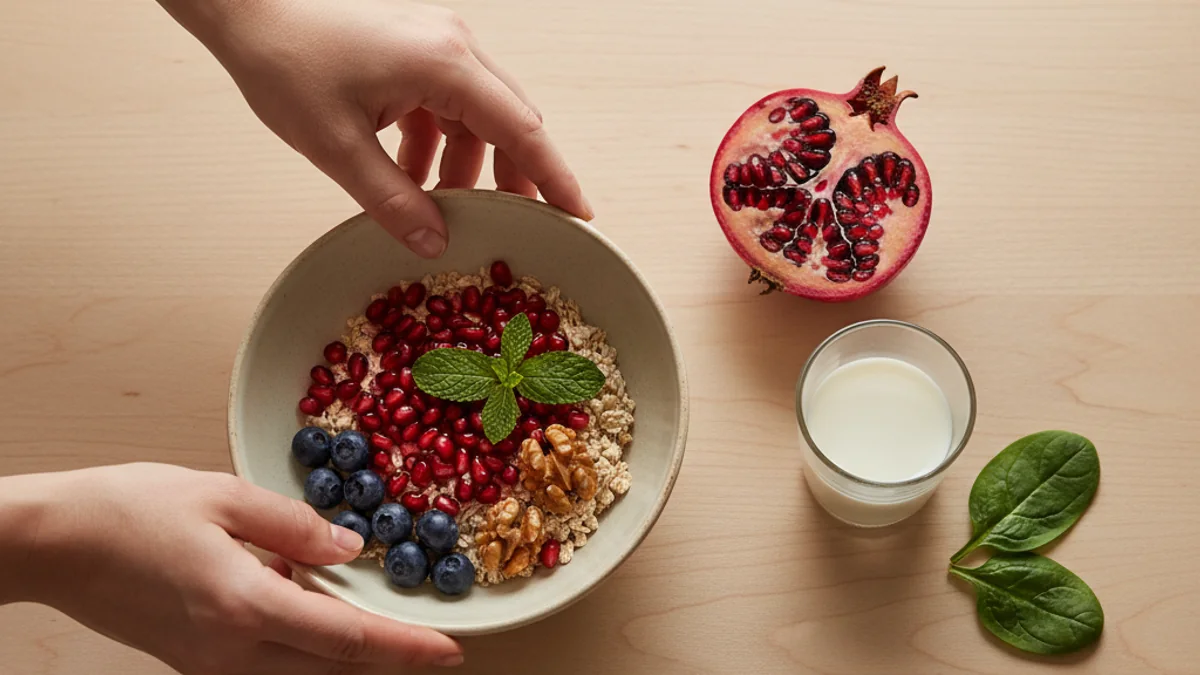
- Food sources: amla, guava, oranges, mosambi, pomegranate, strawberries, bell peppers
A simple early-pregnancy plate I actually recommend
This is what I tell my patients in the clinic:
- Morning: a glass of milk + a handful of soaked almonds + one fruit
- Breakfast: idli / dosa / upma / poha with sambar or chutney + 1–2 eggs (if non-vegetarian)
- Mid-morning: a fruit (orange, pomegranate, apple, pear) or tender coconut water
- Lunch: one cup rice (or ragi, millets) + dal + one leafy green sabzi + curd + one portion of chicken/fish/paneer
- Evening: a cup of milk/tea + roasted chana or a handful of nuts + one seasonal fruit
- Dinner: two chapatis + sabzi + dal + a salad
- Before bed: a glass of milk (optional)
Plus your prenatal vitamin. That is it. No "hCG diet", no exotic supplements, no detox teas.
Foods and habits to avoid in early pregnancy
This list matters more than the "what to eat" list, because the avoid list is evidence-based and the benefits are real.
- Raw or undercooked meat, fish, and eggs — risk of toxoplasmosis, salmonella, listeria
- Unpasteurised milk, soft cheeses, street paneer — listeria risk
- High-mercury fish — shark, swordfish, king mackerel, tilefish
- Raw papaya, pineapple in large amounts — traditional and modern caution; avoid in the first trimester to be safe
- Alcohol — no safe amount in pregnancy
- Smoking and passive smoking — linked to miscarriage, preterm birth, low birth weight
- Caffeine above 200 mg/day — that is roughly 2 small cups of filter coffee
- Excess vitamin A (liver, retinol supplements) — can cause birth defects
- Herbal "pregnancy teas" without medical advice — many contain uterine stimulants
What to do if your hCG actually is low
This is the part that matters. If your beta-hCG came back lower than you expected, the actions are clinical, not dietary.
- Repeat the blood test in 48 hours. The trend is everything. A 53%+ rise is reassuring even from a low baseline.
- Check your dates. If your cycle was irregular or ovulation was delayed, your "4-week" pregnancy may actually be 3 weeks — which explains a "low" number completely.
- Transvaginal ultrasound at the right time. We can usually see a gestational sac when hCG reaches about 1,500–2,000 mIU/mL (the "discriminatory zone"). If hCG is above that and we cannot see a sac in the uterus, we must rule out an ectopic pregnancy urgently.
- Pair it with a clinical assessment. Any bleeding? Any one-sided pelvic pain? Any shoulder-tip pain? These push me toward a same-day scan.
- Serial monitoring. Two or three blood tests 48 hours apart, plus one scan, tells the full story.
I never counsel a patient on a single hCG value. Always the pattern, always with a scan.
When to see me
Please book an appointment urgently if:
- Your beta-hCG is rising less than 53% in 48 hours
- You have bleeding or spotting in early pregnancy
- You have one-sided lower abdominal pain
- You had IVF or IUI and want proper early monitoring
- You have a history of miscarriage or ectopic pregnancy
- You are diabetic, hypothyroid, or on blood thinners
You can book an appointment at my Egmore clinic (morning 8 AM – 2 PM), at the Mylapore branch for an evening slot (5 PM – 9 PM), or at Tambaram on Thursdays and Sundays between 2 PM and 4 PM. For IVF patients, I personally do the first early pregnancy scan.

Related reading
- hCG levels in early pregnancy — what is normal, low, and high — the numbers explained in full.
- Ectopic pregnancy — signs, causes, and why early scanning matters — the reason we care about a single hCG value being low.
- How to prevent miscarriage in early pregnancy — what actually works, and what does not.
For a complete overview of early pregnancy monitoring and antenatal care, see my obstetrics care page.

Dr. Rukkayal Fathima
MBBS, MS (OBG), MRCOG (UK), FRM (Kiel University)
Fertility Specialist, Obstetrician, Gynecologist & Laparoscopic Surgeon
Dr. Rukkayal Fathima is one of India's leading Gynaecologists and the best fertility doctor in Chennai. She has 12+ years of experience and treated 3000+ patients. She specialises in IVF, ICSI, TESA/Micro TESE, IUI, Early Pregnancy Scan, Menopause advice, and Gynaecological surgeries. She is a Co-founder & Director of Yaal Fertility and Women's Centre, the Best Fertility Center in Chennai.
Have Questions About Obstetrics Care?
Every situation is unique. Dr. Rukkayal Fathima provides personalised, evidence-based guidance across multiple locations in Chennai.
Frequently Asked Questions
No — and I have to be honest with you here. No food, drink, supplement, or home remedy directly increases hCG. hCG is produced by the trophoblast cells of the developing placenta, and its level is set by how the pregnancy itself is growing, not by what you eat. What food does do is support a healthy pregnancy environment — and that matters more than chasing an hCG number.
A simple Indian plate works beautifully: dal or legumes (protein, folate, iron), one leafy green vegetable a day (folate), milk or curd (calcium, vitamin D), one fruit (vitamin C + antioxidants), whole grains like ragi or brown rice, and 1–2 eggs a day if you are non-vegetarian. Plus your prenatal vitamin. That is genuinely enough.
In a healthy intrauterine pregnancy, hCG usually doubles every 48–72 hours up to about 6 weeks, then the doubling time slows. A rise of at least 53% in 48 hours is considered reassuring. Below that, we investigate.
No. The only supplements I prescribe in early pregnancy are folic acid (400 mcg), iron (if you are anaemic), calcium, and vitamin D — and these support the baby's development, not hCG production. Avoid anything marketed online as an 'hCG booster' — there is nothing in medicine that does that safely.
Repeat the blood test in 48 hours and do a transvaginal ultrasound. The pattern across two or three readings tells us much more than a single value. In my Egmore clinic, I never treat a single low hCG as a final answer — I pair it with a scan. Low rising hCG can mean an early normal pregnancy (wrong dates), a failing pregnancy, or an ectopic — and each needs a different plan.
Consult Dr. Rukkayal in Chennai
Available at 4 fertility clinic locations across Chennai. Walk-ins welcome; appointments preferred.
No. 747, Poonamallee High Road, Alagappa Nagar, Kilpauk, Chennai – 600 010
No. 149/1, Luz Church Road, Bhaskarapuram, Mylapore, Chennai – 600 004
No. 95, Plot No. 1, Velachery Main Road, Devi Karumariamman Nagar, Pallikaranai, Chennai – 600 100
Dr. Rukkayal is also a visiting consultant at Apollo Hospital, Motherhood Hospital, Cloud Nine Hospital, MGM Hospital, Metha Hospital and St. Isabel Hospital in Chennai. View all clinic locations